
Elon Musk Unveils Tesla's Flying Roadster: A Car That Jumps, Flips and Lands Using SpaceX Rocket Technology
Tesla's long-awaited electric supercar has finally taken to the air, using powerful compressed-air thrusters to perform extraordinary stunts. But is the new Roadster a genuine flying car, or an advanced electric vehicle capable of controlled jumps?
A Tesla That Can Fly? Elon Musk Just Showed the World Something Extraordinary
Imagine driving an electric sports car that can accelerate faster than almost anything on the road, launch itself into the air, rotate above other vehicles and land back on its wheels.
It sounds like something from a science-fiction movie, but Elon Musk has brought that vision closer to reality.
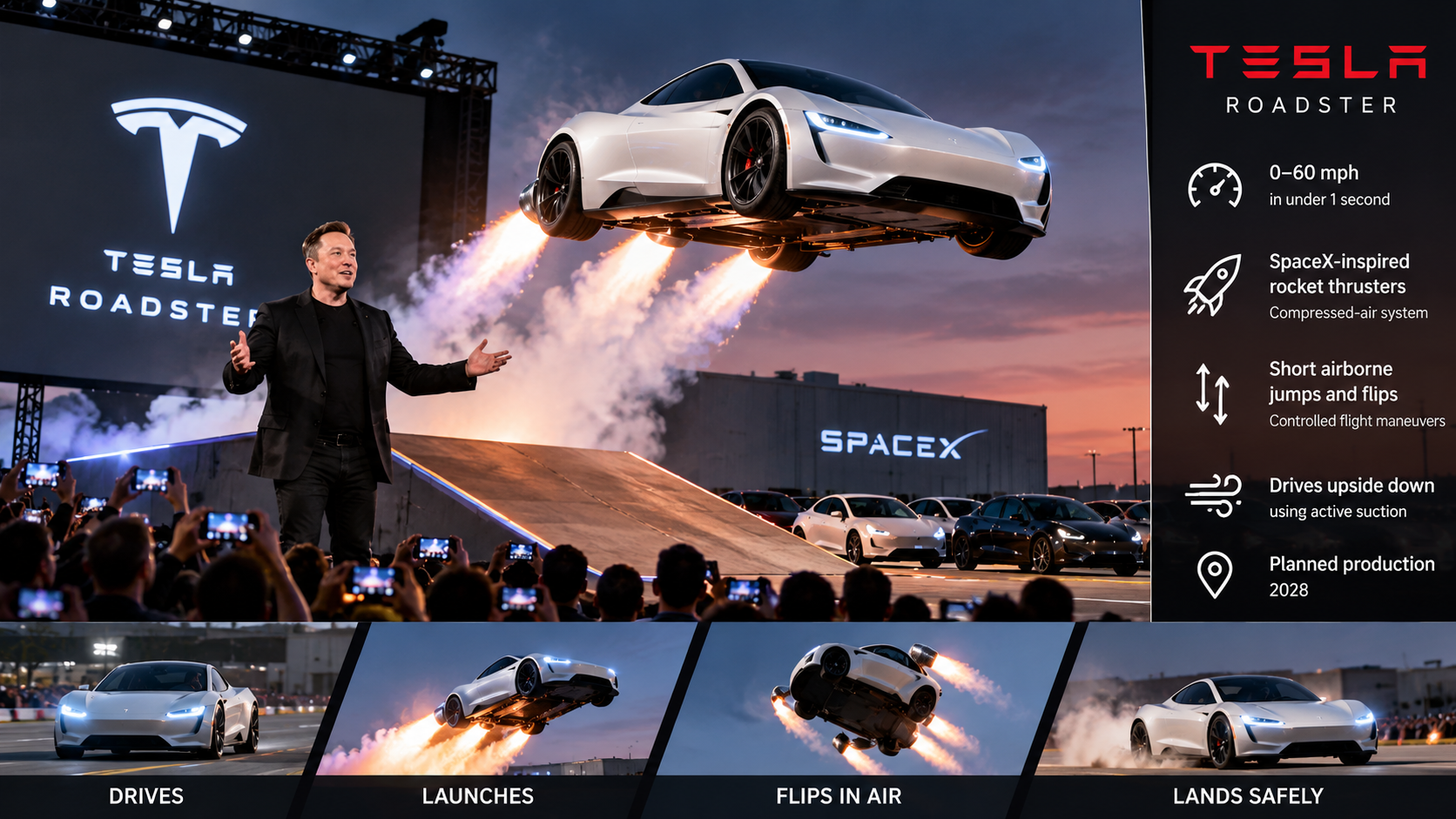
On October 15, 2026, Tesla unveiled its redesigned second-generation Roadster at a SpaceX testing facility in McGregor, Texas, showcasing a vehicle equipped with rocket-inspired technology developed through collaboration between Tesla and SpaceX.
The demonstration featured a futuristic white electric sports car performing maneuvers rarely associated with automobiles.
The Roadster drove upside down along a specially designed curved ramp, rotated through the air and landed on its wheels. In another demonstration, it used its thrusters to jump over a lineup of Tesla vehicles.
The performance immediately raised a fascinating question: Has Elon Musk finally created a flying car, or is the Roadster simply a car that can jump and fall safely?
The answer lies in the technology behind its extraordinary movements.
Flying Car or Falling Car? What Actually Happened?
The new Tesla Roadster demonstrated the ability to leave the ground and control its movement in midair.
But there is an important distinction between briefly becoming airborne and operating as a practical flying vehicle.
A conventional airplane generates lift through its wings. A helicopter uses rotating blades to remain airborne.
Tesla's Roadster takes a different approach.
Instead of relying on wings, the vehicle uses powerful thrusters that release highly pressurized gas to produce force.
During the demonstration, the Roadster used these systems to launch itself off the ground, rotate in the air and control its landing.
That makes the Roadster more than an ordinary jumping car. Its thrusters provide a degree of active control while airborne.
However, Tesla has not yet demonstrated that the Roadster can travel long distances through the air, maintain sustained flight or operate like a conventional aircraft.
For now, the most accurate description is a rocket-assisted electric sports car capable of short, controlled airborne maneuvers.
It can leave the ground, but calling it a fully functional flying car would be premature.
How Do the SpaceX Rocket Boosters Work?
One of the most remarkable features of the new Roadster is its propulsion system.
Tesla has incorporated rocket-inspired technology developed with SpaceX, Musk's aerospace company.
However, the Roadster does not use conventional rocket fuel to perform its airborne maneuvers.
Instead, it relies on an ultra-high-pressure compressed-gas system.
Here is how the technology works:
Compressed-gas storage: Extremely high-pressure gas is stored inside specialized pressure vessels.
Thruster activation: The system releases gas rapidly through carefully positioned nozzles.
Force generation: The escaping gas produces thrust in the opposite direction, following Newton's third law of motion.
Vehicle movement: Depending on which thrusters activate, the car can accelerate, lift, rotate or adjust its position in the air.
Controlled landing: The thrusters help manage the vehicle's orientation and movement before it returns to the ground.
The principle is similar to the reaction-control systems used by spacecraft, although the Roadster's engineering and operating environment are different.
Reports indicate that the system uses multiple nozzles to control acceleration and airborne movement.
This combination of electric propulsion and compressed-gas thrust creates capabilities that traditional electric sports cars do not possess.
The Roadster Can Drive Upside Down, Too
Flying was not the only surprising part of Tesla's demonstration.
The Roadster also traveled along an inverted section of a specially constructed ramp.
Normally, a car driving upside down would fall because gravity pulls it toward the ground.
Tesla demonstrated a different solution using a powerful suction system.
The technology creates downward aerodynamic force by using fans to generate low pressure beneath the vehicle.
This helps hold the car against the driving surface, even when the surface curves overhead.
Unlike ordinary aerodynamic downforce, which generally increases with vehicle speed, an active fan-based system can generate significant suction at relatively low speeds.
During the event, the Roadster combined this system with its thrusters to perform a dramatic sequence involving inverted driving, airborne rotation and landing.
Although impressive, this was a controlled demonstration on specialized equipment, not proof that the Roadster could safely perform the same maneuver on ordinary public roads.
From 0 to 60 MPH in Less Than One Second
Beyond its flying capabilities, Tesla is positioning the Roadster as an exceptionally fast electric sports car.
Company executives presented performance figures that could place it among the quickest-accelerating production-intended vehicles ever developed.
Tesla Roadster: Reported Specifications
Feature | Announced details |
|---|---|
Vehicle | Second-generation Tesla Roadster |
Powertrain | Fully electric |
Additional propulsion | SpaceX-inspired compressed-gas thrusters |
Acceleration | 0–60 mph in under 1 second |
Top speed | More than 230 mph (370 km/h) |
Driving range | More than 300 miles (480 km) per charge |
Airborne capability | Short controlled jumps and rotations |
Inverted driving | Demonstrated using active suction |
Planned production | 2028 |
These are Tesla's announced figures and demonstration capabilities, not independently established specifications for customer-delivered production vehicles.
For perspective, accelerating from 0 to 60 mph in approximately 0.8 seconds would expose occupants to extremely strong acceleration forces.
Achieving such performance requires extraordinary traction, precise vehicle control and carefully engineered safety systems.
The Roadster's combination of electric motors and auxiliary thrusters is intended to push beyond the limitations of conventional tire-powered acceleration.
Tesla's Three Roadster Versions: Performance, Thrust and Rocket
Tesla's updated reservation information describes three different Roadster configurations.
Performance Roadster
This version is positioned as the more conventional high-performance electric sports car. Reuters reported a reservation deposit of $50,000 for the Performance version.
Thrust Roadster
The Thrust configuration adds acceleration thrusters designed to provide capabilities beyond those of a conventional electric drivetrain.
Its reported reservation deposit is $250,000.
Rocket Roadster
The most extreme version is an invitation-only, single-seat configuration described as having a full flight system.
This version represents Tesla's most ambitious interpretation of the Roadster concept.
However, the availability of a reservation option does not mean a vehicle has received approval for unrestricted public-road or airborne operation.
Tesla did not announce definitive final selling prices for these versions at the October 15 event. Reservation deposits should not be confused with purchase prices.
Why Did It Take Tesla Almost a Decade?
The second-generation Roadster has a long history of ambitious promises and delayed production schedules.
Tesla originally revealed the concept in November 2017, promising remarkable performance and a driving range of approximately 620 miles.
At the time, production was expected to begin in 2020.
That deadline passed, followed by several additional delays.
Nearly nine years after the original reveal, Tesla has now presented a redesigned version featuring technology substantially different from its initial concept.
Interestingly, the newly announced driving range of more than 300 miles is considerably lower than the approximately 620 miles originally promoted.
That difference highlights how the vehicle's design priorities may have shifted toward extreme performance and experimental propulsion.
Musk now says production is planned for 2028.
Whether Tesla can meet that target remains uncertain.
Could You Legally Drive a Flying Tesla on Public Roads?
The Roadster's technological capabilities raise questions that extend beyond engineering.
A car capable of leaving the ground presents challenges for existing vehicle safety and aviation regulations.
Traditional road vehicles must comply with automotive safety standards, while aircraft are subject to a separate regulatory framework.
But what happens when a vehicle combines elements of both?
According to reporting by CBS News, the regulatory responsibilities surrounding a car capable of airborne movement are not yet fully settled.
The US Federal Aviation Administration has indicated that Tesla's vehicle does not meet its definition of an aircraft.
Meanwhile, Tesla's flying configuration has not been approved for general public-road use.
Even if the Roadster can perform controlled jumps on a test track, that does not establish that similar maneuvers would be safe or legal in traffic.
Questions remain about passenger protection, surrounding vehicles, landing zones, equipment reliability and emergency procedures.
These challenges could ultimately prove more difficult than the demonstration itself.
Is the Roadster Really the Future of Transportation?
The Roadster represents a striking combination of automotive and aerospace engineering.
Its compressed-gas propulsion system could demonstrate new ways of controlling vehicle motion, while its active suction technology pushes the boundaries of conventional road-car design.
But there is a difference between technological possibility and practical transportation.
For an airborne vehicle to become useful in everyday life, it would need to demonstrate repeatable performance, reliable safety systems, manageable operating costs and regulatory compliance.
The Roadster has not yet established all of those capabilities.
It is also unlikely to become an affordable everyday vehicle, particularly given its advanced engineering and the substantial deposits associated with its specialized versions.
For Tesla, the Roadster may be less about replacing ordinary cars and more about demonstrating what its engineers can achieve.
It also arrives as Tesla increasingly emphasizes autonomous driving, artificial intelligence and robotics alongside its traditional electric vehicle business.
Elon Musk's Biggest Challenge: Turning a Spectacular Demonstration Into a Real Product
Tesla has already demonstrated that a car can use powerful thrusters to jump, rotate and land in a controlled environment.
That is an impressive engineering achievement.
But the company's next challenge is considerably larger.
It must transform an experimental demonstration into a vehicle that customers can own, operate and maintain safely.
Tesla will need to prove that the propulsion system can withstand repeated use, that its airborne maneuvers remain predictable and that its engineering can satisfy relevant safety requirements.
The company's history of delayed Roadster promises also means that many potential customers and industry observers will want to see actual production vehicles before treating the latest timeline as certain.
Final Verdict: Flying Car, Rocket Car or Controlled Falling Machine?
Elon Musk's new Roadster is not simply an ordinary electric car with a powerful engine.
It combines an electric drivetrain, SpaceX-inspired compressed-gas thrusters and an active suction system to achieve movements that conventional cars cannot perform.
The demonstration showed the Roadster leaving the ground, rotating in the air and landing under controlled conditions.
But it did not establish the kind of sustained, practical flight associated with aircraft.
So, is it a flying car or a falling car?
The most accurate answer today is that it is a rocket-assisted electric sports car capable of brief, controlled flight-like maneuvers.
Whether future versions can go beyond short jumps remains to be seen.
Elon Musk has shown that a car can do more than drive. Now Tesla must prove that its extraordinary Roadster can become more than an extraordinary demonstration.